Rolamentos de giro ou rolamentos de mesa giratória são rolamentos de esferas ou rolos que consistem em dois ou mais anéis concêntricos que podem incluir o diâmetro da engrenagem. Os rolamentos melhoram o suporte de carga e a transmissão de potência em todas as direções. Eles são projetados para suportar cargas extremas de momento axial, radial e de inclinação.
A NSAR oferece rolamentos de giro de alta qualidade em todos os tamanhos.
Construção de rolamentos giratórios
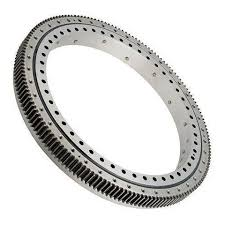
Slewing bearings consist of an inner and outer ring, both of which are usually equipped with gears. There are connecting holes in both rings, which allows for optimized power transmission and simple and fast connection of adjacent machine parts.
Slewing bearings are generally large rolling bearings that can accommodate axial, radial and moment loads acting in any direction, either alone or in combination. They can perform both slewing (oscillating) and rotational movements.
Aplicações de rolamentos de giro em diferentes indústrias
These bearings are available in a variety of designs depending on your application requirements and can be used in a wide range of industries.
The power and versatility of these bearings make them increasingly valuable in the following industries:
Construção - Supporting heavy loads for slow applications and large equipment such as construction cranes
Industrial - Mining, Steel, Agriculture, Oil and Gas
Equipamento Robótico
Máquinas-ferramentas
Aplicações Médicas
Aeroespacial e Defesa
Slewing rings are designed to provide high-precision support and mobility. They may have very complex bolt hole patterns on both the inner and outer rings to facilitate installation.
Slewing rings have relatively thin cross-sections compared to other rolling bearings. They require the structure they are bolted to be rigid enough not to exceed pre-defined deflection limits under load.
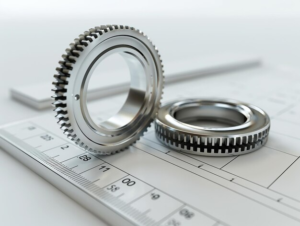
Falhas comuns no rolamento do anel giratório
Compreender as causas comuns de
rolamento de giro falhas é fundamental para controlar o tempo de inatividade e prolongar a vida útil do equipamento.
Aqui estão os tipos mais comuns de falhas e suas causas:
Excessive Wear of Raceways and Rolling Elements
Wear is a natural result of long-term, continuous use. However, excessive wear can lead to premature bearing failure and surface degradation of raceways and rolling elements.
Causas:
Inadequate lubrication: causes increased friction and metal-to-metal contact.
Contamination: The ingress of dirt, dust or other particles accelerates wear.
Misalignment: Uneven load distribution increases localized stress and wear.
Spalling – Flaking or pitting of the bearing surface
Spalling is caused by material fatigue, which causes debris to break off the bearing surface. This can lead to raceway roughness, increased vibration and noise.
Causas:
Material fatigue: Over time, repeated stress cycles weaken the material.
Overload: Bearings are subjected to loads that exceed their design capacity.
Improper heat treatment: Resulting in insufficient hardness and durability of the bearing material.
Brinell Indentation
Excessive static or shock loads can cause a phenomenon called brinelling, which appears as an indentation or permanent deformation in the raceway. Localized stresses can cause this type of damage and can severely affect the performance and life of the affected component.
Causas:
Excessive static loads: Heavy loads over a long period of time can cause permanent deformation.
Shock or impact loads: Sudden forces during installation or operation.
More support needed: Inadequate support of the bearing rings by the bearing housing or structure.
Corrosion – Degradation of the bearing surface due to chemical reactions
Corrosion occurs when the bearing surface reacts with moisture or chemicals, resulting in surface pitting and weakened structural integrity.
Causas:
Exposure to moisture/chemicals: Bearings in harsh environments are susceptible.
Inadequate sealing: Allows moisture and contaminants to enter.
Improper maintenance: Fails to protect bearings from corrosive factors.
Cracking
Severe stresses can cause cracks in the raceways or rolling elements, which can create visible cracks that compromise the integrity and performance of the bearing.
Causas:
Severe overloading: Forces that exceed the load-bearing capacity can cause stress fractures.
Material defects: Impurities or inconsistencies in the bearing steel.
Thermal stresses: Extreme temperature changes can cause expansion and contraction stresses.
False brinelling: This is similar to brinelling, but is caused by vibrations
False brinelling is a wear mark caused by vibrations and oscillations from insufficient rotation, which can cause fretting corrosion.
 Causas:
Vibration/oscillation: Occurs in fixed bearings that are subject to vibration.
Poor bearing fit: Looseness can cause micro-movement.
Transport vibration: Bearings vibrate during transportation, which can cause wear.
Contamination - Presence of foreign particles, causing wear
Contamination within the bearing can cause the presence of foreign particles, which can cause wear and premature failure.
Causas:
Inadequate seals: Allow dirt, dust and contaminants to enter.
Contaminated lubricant: Foreign particles are mixed into the lubricant.
Poor cleanliness: During installation or maintenance, contaminants are present.
Lubrication failure
Lubrication failure results in an inadequate lubricating film, which causes increased friction, heat generation and wear.
Causas:
Wrong lubricant: Use of unsuitable or low-quality lubricant.
Inadequate lubrication intervals: More frequent relubrication or maintenance is required.
Environmental factors: Conditions that degrade lubricant performance (such as extreme temperatures).
Implementar medidas preventivas
Practice preventive measures can significantly reduce slewing bearing failures. Regular inspections, proper lubrication, adequate sealing, proper load management and adherence to installation guidelines are essential to maintain the life and performance of slewing bearings.
Understanding these types of failures and their causes allows for proactive maintenance and helps ensure reliable operation in heavy machinery applications.


