Nuestras guías y
carcasas work together to solve countless engineering challenges across numerous industries and applications. Therefore, sizing and selecting an assembly or linear guide system should be a careful and systematic process.
Choosing the right linear motion supplier and product can be a difficult process. Incorporating incorrectly sized or poor quality components will compromise the performance of the OEM product. Machine motion will be slower and less accurate, resulting in lower production yields, incorrect component placement, and potential end-product damage. Machine downtime and failures will become more frequent. Slide life will be shortened, and maintenance costs will rise.

Nuestros consejos para seleccionar las mejores guías lineales:
1. Verifique las capacidades de carga estática, dinámica y de momento
Lo primero que debe considerar son las cargas que se aplicarán a su sistema de guía lineal. ¿La vía guía solo soportará cargas estáticas o también necesitará soportar cargas dinámicas cuando esté en movimiento? Los fabricantes enumerarán las capacidades de carga estática y dinámica máximas para ese
guía lineal particular to make selection easier. Static load refers to the static load that occurs when the linear component is fixed or stationary. Static load ratings are always higher than dynamic load ratings. You need to choose the type of guideway based on your needs.
Linear Guideways manufacturers will also list moment load ratings, and these must also be carefully considered. If the linear guides and rails are likely to experience moment loads, a dual rail setup can minimize rolling moment loads by distributing the forces to one or two linear guides on each rail. The life of the linear system will be greatly extended by using a dual rail configuration and therefore eliminating any moment loads.
 2. Consideraciones de diseño e instalación
Having considered static and dynamic load capacities, the next consideration should be the layout of the linear system. A single rail with one linear guide may be sufficient, but as mentioned previously, if there are over-suspended moment loads, using a dual rail setup (with one or more linear guides per rail) may eliminate these moment loads by distributing the loads across two rails.
Ensuring that the prepared surface is suitable for mounting the linear guides is critical and should be carefully considered. The surface should be flat, clean, and when using a dual rail setup, the rails should be checked for alignment after installation.
Instrucciones de instalación Para todas las guías lineales se puede encontrar en la hoja de datos.
3. Considere los requisitos de velocidad y aceleración.
La velocidad crítica debe ser la siguiente consideración al seleccionar una guía lineal. La velocidad a la que necesita que funcione su sistema lineal limitará su selección. Normalmente, las guías lineales perfiladas tienen una velocidad máxima permitida de 3-5 m/s y una aceleración de 300 m/s2.
4. ¿Qué clase de precisión se requiere para la aplicación?
Una vez que se especifican la carga, la velocidad y el diseño, es fundamental garantizar que su sistema lineal sea repetible para lograr el resultado final deseado. Los fabricantes de guías lineales muestran la clase de precisión como el paralelismo de avance a lo largo de una longitud de guía definida y la desviación a lo largo de una longitud predeterminada en micras. La clase de precisión se define entonces como N, H, P, SP y UP. Utilizando estas tablas y haciendo coincidir la clase con los requisitos de la máquina, se puede realizar la selección correcta de la guía lineal.
5. Longitud del recorrido (carrera)
A simple but critical step in linear guide selection. Calculate the total travel length required, remembering to account for the "lost" travel from the length of the linear guide. If the total travel needs to be more than 4000mm, a butt joint is required to achieve a smooth joint where the two linear guides join. NSAR can provide a perfectly finished end to the butt joint, allowing for smooth, quiet linear motion throughout the entire travel.
6. Selección de guía lineal y condiciones ambientales.
It is critical to consider the conditions in which the linear guide system will operate. If the environmental conditions are likely to be harsh, it is important to ensure that the correct seals and scrapers are selected to ensure a long service life. We has a market-leading range of seals and scrapers that protect against contaminants such as dust and chips.
Linear guides are widely used in various industries such as robotics, laboratory equipment, machine tools, 3D printing, etc. NSAR produces innovative, market-leading linear solutions.
7. Considere el impacto de los materiales y recubrimientos en el costo y el tiempo de entrega.
Al especificar rodamientos, la gente tiende a centrarse en los parámetros mecánicos, mientras que los materiales y revestimientos se consideran menos importantes. De hecho, los materiales y revestimientos pueden tener un impacto significativo en el proyecto, no sólo desde una perspectiva de rendimiento, sino también desde una perspectiva de costo y tiempo de entrega. Por ejemplo, las opciones anticorrosión pueden incluir de todo, desde un cromado fino y denso hasta varios cromados negros. En algunos casos, elegir una versión de acero inoxidable de la guía lineal puede proporcionar una solución más eficaz.
 8. Elige la mejor guía lineal para ti
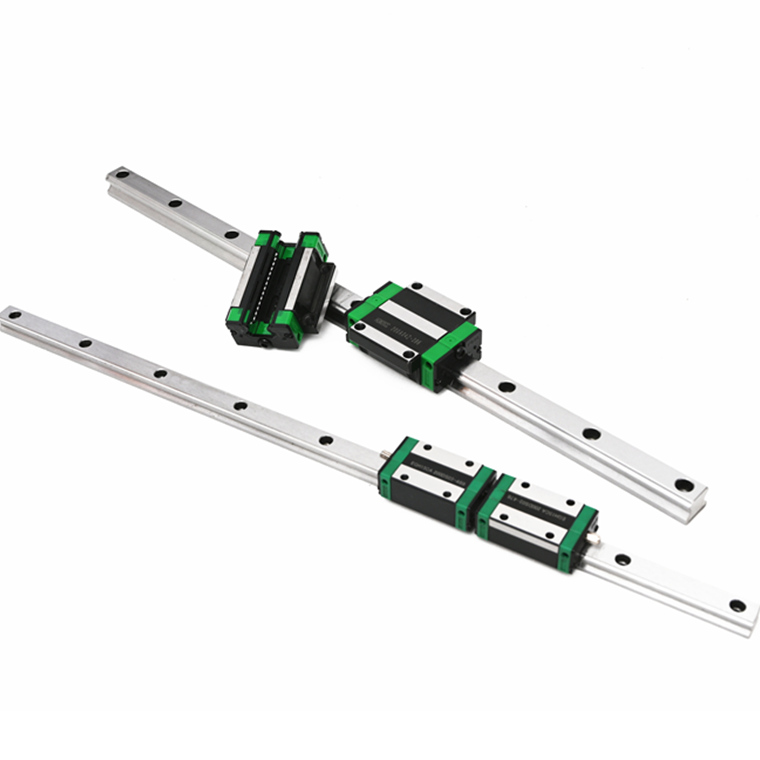
In summary, the choice of linear guide is critical to achieving the best performance of your linear motion system.
Whether you choose profile, flat, round or square guides, smart choices ensure seamless, easy mechanical operation.
Haga clic para ver los productos de rodamientos compatibles con NSAR.
9. Personalice los productos para obtener una ventaja competitiva
Más del 50% de los productos de movimiento lineal se fabrican a medida. ¿Por qué? Porque
OEM Quieren crear productos que ofrezcan una ventaja competitiva única. Este objetivo requiere que los componentes sean más ligeros, más pequeños y capaces de soportar mayores fuerzas, velocidades y cargas. Puede requerir jaulas modificadas, revestimientos especiales o materiales resistentes a la corrosión.


